
Transformational Roadmap

Lean Change Approach to Disciplined Agile Transformation
Achieve business agility by empowering a measurement driven transformation that attends to the organizational culture. Process Mentors has trained thousands of individuals and coached hundreds of teams transitioning to delivering value with Disciplined Agile.
01. Assessment & Adoption Strategy Options
Short assessment if transitioning from a traditional approach. Agility health check if an agile way of working is already in place. Understand the current state, understand the culture, and understand the readiness for change. Select options that are fit for purpose.
04. Just-In-Time Training & Coaching
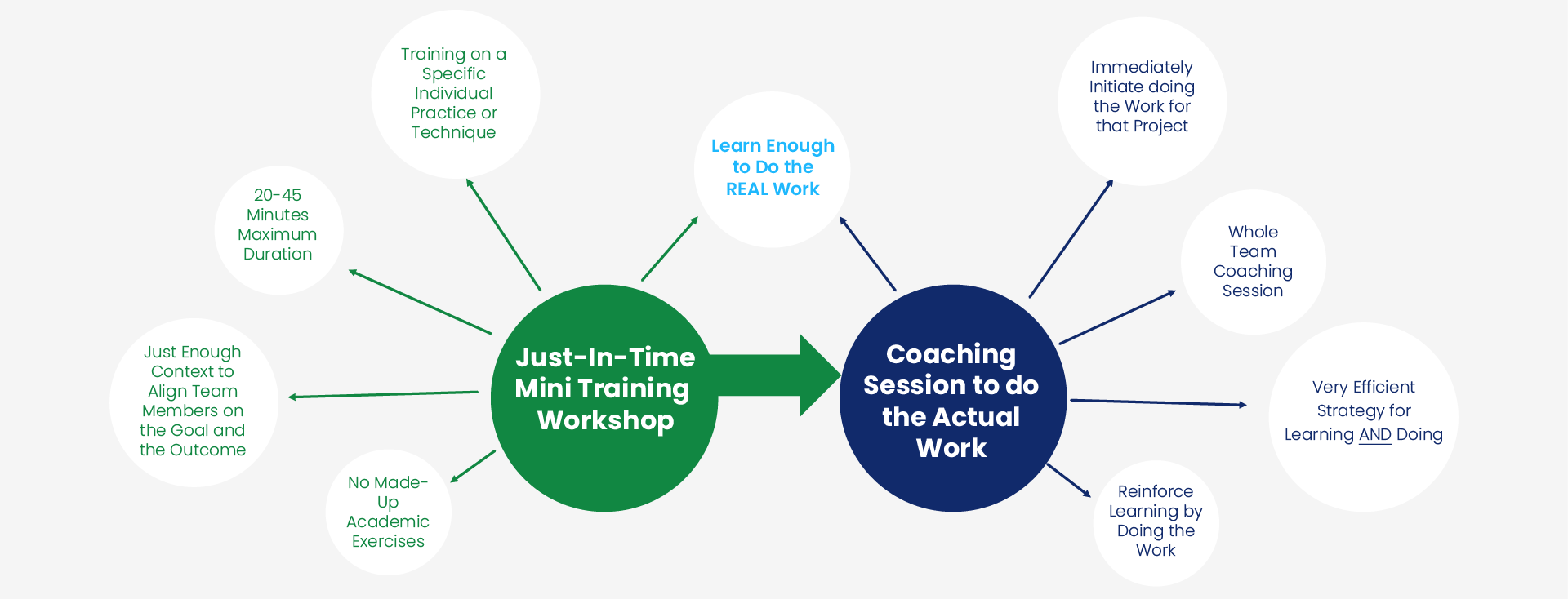
Success assurance & accelerator – training at the right moment to set the context of a practice or technique combined with coaching to do the work.
02. What Good Looks Like
Create a transformational roadmap based on selected options and a vision for success. The focus is on outcomes rather than vanity measures. Define what good looks like and how it will be measured.
05. Measuring Success
Using measures from what good looks like, provide visibility into success being achieved. The goal should never be to be agile; it should be to achieve business agility and become a learning organization.
03. Foundational Training
Train the leadership. Train the team members together. Train the stakeholders and subject matter experts. Develop a training plan with options for the needed foundational context based on the role.
The Beginning, Challenges, and Opportunities of a DA Transformation
For the past several weeks, Joshua Barnes hosted leading experts actively engaged with DA implementations to discuss a range of important DA topics. Anitra Tanner discussed “The Beginning of a DA Transformation,” Jimi Washburn talked about “The Challenges of Starting a DA Transformation,” and Karen Lewis detailed key aspects on “Agile Transformations at Scale – Challenges and Opportunities.”
01. Assessment & Adoption Strategy Options
Transitioning from a traditional approach? Conduct a short duration assessment to understand readiness to adopt an agile way of working. Agile way of working is already in practice? Get an agility health check to set a baseline. Assessment or agility health check, key information gathered includes: understand the current state, understand the culture, and understand the readiness for change. We pull from a large pool of assessment criteria ensuring the criterion are valuable and fit for purpose of each organization’s unique context.
Sample Criteria
- Items being worked on are of high value
- Items being worked on are small
- Teams are decoupled (as independent as possible)
- Few hand-offs and hand-backs
- Costs of delay at the Minimum Business Increment (MBI) identified
- Organizational culture is being attended to
- All work and workflow is visible
- Context of the problems with work being done is visualized
- Work level does not exceed capacity
- Alignment of Budgeting, Portfolio and Product Management around products
02. What Good Looks Like
Create a transformational roadmap based on selected options and a vision for success. The focus is on outcomes rather than vanity measures. Define what good looks like and how it will be measured.
Business Value & Outcomes
Measure indicators that provide visibility into an increased probability of teams delivering meaningful business value. Small delivery increments, continuously adjusted to what is needed with the ability to change direction at low cost.
Mindset
Mindset and collective ownership are less visible yet much more powerful than tools and techniques or even practices. Becoming a learning organization is contingent on the change in the agile team members’ mindset and everyone in the value stream.
Process Adoption
Organizational transformations are expensive. Measure that an agile way of working is being adopted vs. agile in name only. The goal is not to start all projects/initiatives as “agile” and claim success. It is to improve value delivery using lean and agile principles, practices, and techniques.
03. Foundational Training
Train leadership. Train the team members together. Train the stakeholders and subject matter experts. Develop a training plan with options for foundational context based on the role, team, or other aspects.
The training plan is a component of the transformation roadmap and overall strategy. How much foundational training is needed? What level provides the best value based on the role of attendees? Does everyone need to be certified by an external governing body such as PMI? Should only a subset of the organization earn an external certification? Would the organization benefit from a certification that is configured to its specific context and goals? Is certification a consideration at all? These are all critical questions and choices required to achieve agility while balancing the cost required for the journey.
Choices:
Foundational Training
PMI Disciplined Agile Scrum Master Certification Course. 2-day training covering agile and lean approaches like Scrum and Kanban along with how to use the DA tool kit and chose your way of working (WoW).
Advanced Foundational Training
PMI Disciplined Agile Senior Scrum Master Certification. 2-day training focused on tailoring your approach and leading your team with Disciplined Agile.
Right Sized Foundational Training
Process Mentors agile and lean foundation training and the DA tool kit. Offerings include options ranging from 2-, 4-, and 8-hour durations.
Foundational Boot Camps
Process Mentors Boot Camps. 2-day Agile and Lean Boot Camp. 1-day Product Owner Boot Camp. 1-day Agile for Managers Boot Camp. 1-day Leadership Team Boot Camp.
04. Just-In-Time Training & Coaching
Success assurance & accelerator – training at the right moment to set the context of a practice or technique combined with coaching to do the work. Once a team has chosen its way of working, just-in-time training focuses on doing that way of working.
05. Measuring Success
The goal should never be to “be agile”; it should be to achieve business agility and become a learning organization. Our approach for measuring success in transitioning to an agile way of working focuses on three categories with weighting applied to them. As a starting point, we would weight the success measures: 60% Outcomes, 20% Mindset, and 20% Process Adoption.
Based on the measurement options chosen to define what good looks like, success is measured. The first 30 days of adopting an agile way of working set a solid platform to build on. Measures here center on impediments that must be swiftly removed. The following 60 days focus on if a shift in mindset is happening and is progress on the adoption aspect. As teams get into this 60 day period, we also measure the increased probability of the value delivery. Is working functionality meeting a definition of done? Is there a high level of collaboration with Stakeholders? Is feedback being incorporated?
06. Adoption Strategy Summary
Just like there is no single framework or process recipe that works for all teams, there is no single adoption strategy. Each team is unique. Disciplined Agile provides the tool kit for each team to choose its way of working based on their context. Equally important for their adoption’s success, the strategy to support that success must be chosen to be fit for purpose based on their context.
01. Train the Foundations
Foundations training that sets or reset the basics can vary by team, product, or value stream. Chose the amount that is fit for purpose.
02. Train Individual Practices & Techniques
Foundations training that sets or reset the basics can vary by team, product, or value stream. Chose the amount that is fit for purpose.
03. Do the Work with Coaching Support
Enable teams to “do their way of working”. Immediately after a practice level Just-In-Time training, coach the teams to do the work.
.
04. Continuously Make Improvements
Become a learning team in a learning organization. Continuously improve with coaching support and guidance from Disciplined Agile.
 Process Mentors helps implement lean and agile methodologies to streamline processes in a context-sensitive manner.
Quick Links
Latest Posts
Disciplined Agile Courses Now Available on LinkedIn!
I am excited to share with you that my first on-demand LinkedIn Learning course, “Introduction to Disciplined Agile,” is now live. This is the first in a suite of LinkedIn learning courses on Disciplined Agile that I will be releasing that will include covering: DA...
The Value of Process Mentors Agile and Lean Boot Camp
The learning approach that has consistently yielded the best results is our Just-In-Time training strategy. As one of the most valuable aspects of the Process Mentors transformational roadmap to achieving business agility, in almost all situations, the best option is...